Monday, July 6, 2009

The Buddha Meets The Dark Lord

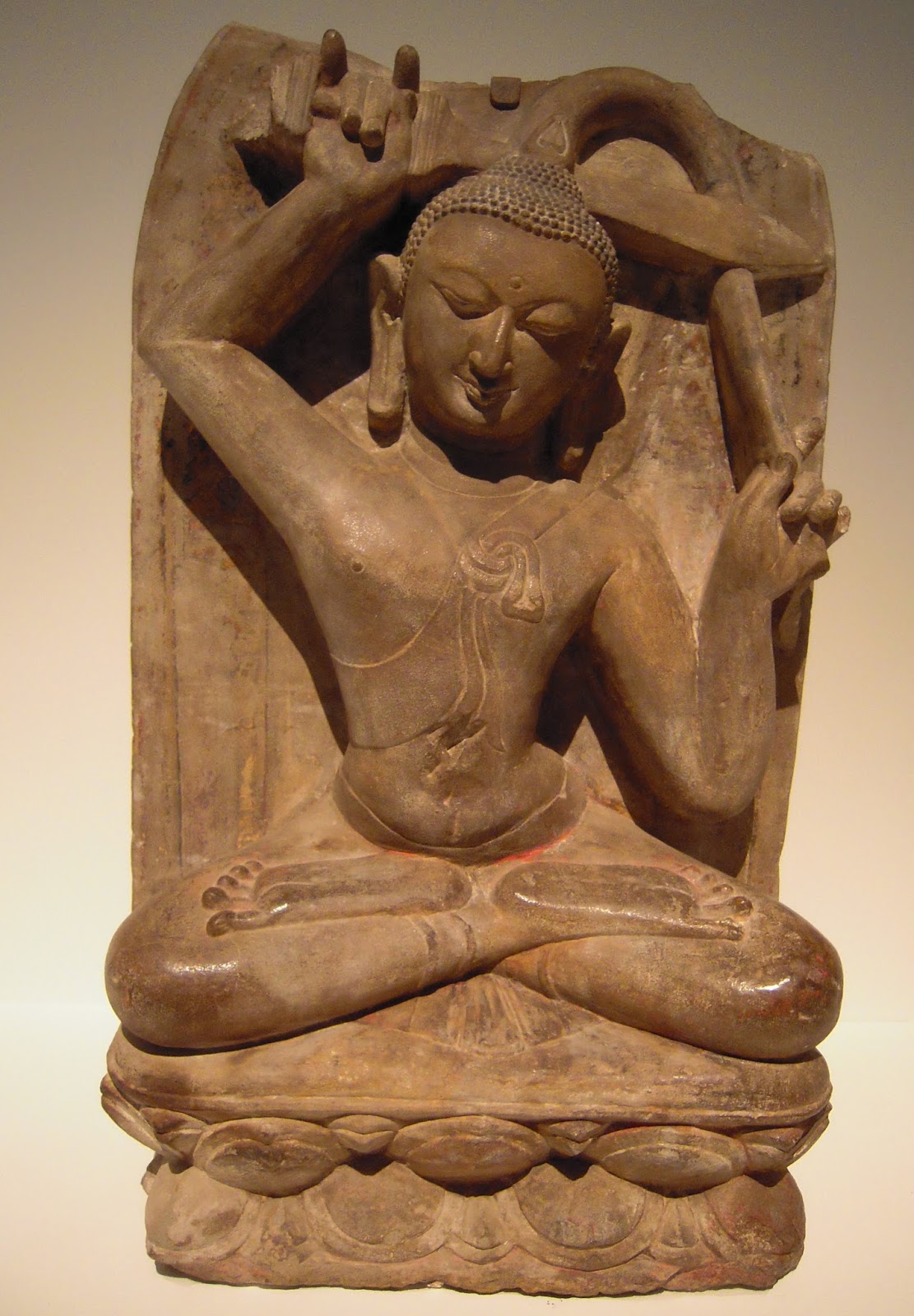
The Padhana Sutta in the Sutta Nipata is the earliest version of the ‘Buddha verses Mara’ story and, incidentally, the only one found in the Pali Tipitaka. This sutta is interesting for a variety of reasons. For example, Mara tells the Buddha that he has pursued him ‘for seven years’ (satta vassani), whereas tradition tells us that the Buddha’s quest for truth lasted six years. Mara’s army is made up, not of monsters and ghouls, but various negative psychological traits and states of physical deprivation, underlining the story’s allegorical and didactic intent. In verse 444 the Buddha tells Mara that after he has attained enlightenment he will ‘go from country to country training many disciples’. In other words, he had already decided to teach the Dhamma even before his encounter with Brahma Sahampati after his enlightenment (Vin.I,6-7).
However, in this post I would like to examine verse 449 from the Padhana Sutta. The verse describes Mara’s defeat’ and reads, ‘The lute fell from the armpit of that one overcome with disappointment. Then that discouraged one disappeared there and then’. Now throughout the sutta the Buddha’s adversary is called by three names – Mara, Namuci or Kanha. Now this last name can be translated as ‘Dark One’ or ‘Darky’ and of course its Sanskrit equivalent is Krishna. Now we meet with Krishna under his alternative name of Vasudeva in the Ghata Jataka (No.454), a story very similar to the one about Krishna in the Bhagavata Purana. But what is the Hindu god Krishna doing trying to hinder the Buddha attaining enlightenment in the Sutta Nipata? Well, Krishna is probably the most amorphous of all Hindu deities. He can be the insatiable lover, (some Indians even associate the blue color of Viagra pills with Krishna), the adorable child, the trickster, the brave warrior, the noble friend, the thoughtful philosopher, the incarnation of God, etc. He is most commonly depicted today playing a flute, and in earlier times, a lute (vina), as in the Sutta Nipata. The best ‘biography’ of Krishna I know of is in Trevor Ling’s outstanding ‘A History of Religion East and West’ (1968). But whatever Krishna became later, he started off as an aboriginal fertility god, similar to Pan (you know, dalliancing in the wood with the shepherdesses and playing his pan pipes). His aboriginal origins also explain his color, although the Aryan distaste of blackness caused him to become blue as he was gradually incorporated into Hinduism. But at the time of the Buddha, Krishna was popular but minor a god of sensual love and in that role he tried to distract the Buddha from his noble quest.

Sunday, July 5, 2009

A Recollection On Blessings

Infinite in number and variety are the states of existence that beings are born into. I have been born as a human beings.

Countless are those who cannot speak or hear what is spoken to them, who cannot see to read and who lack the power to reason and ponder. I have been born with all limbs and faculties complete.

Many are those who dwell in lands of strife and conflict and who are deprived of security and safety. I am living in a land that is at peace.

Incalculable are those forced to toil without end and who are driven by hunger and want. I have wealth to sustain the body and time to give it rest.

Numerous are those whose bodies and minds are in bonds, who are not their own masters, unable to go where they wish, unable to think as they like, I enjoy great freedom.

Without number are those who abide in regions where the light of the Dhamma shines not, or where its message is not heard above the racket of false doctrines. I have heard and understood the good Dhamma.

Truly precious is this human life and great are the blessings I enjoy. I here and now before the Buddha contemplate my own good fortune and resolve to use this rare opportunity to work for my own good and the good of others. With strong determination I will overcome all obstacles both great and small.

Saturday, July 4, 2009

Quotes

I found these quotes on an atheist website. I thought some of them were rather good. However, I notice that most of them, like discussions on religion in general, assume that religion means belief in a god, and in one god in particular. Thats a pity. I think its time we get together with the Jains, the Taoists and the Confucianists and start a Society For The Better Understanding Of God-free Religions.
(1) An atheist is a man who has no invisible means of support. John Buchan
(2) Calling atheism a religion is like calling bald a hair color. Don Hirschberg
(3) Philosophy is questions that may never be answered. Religion is answers that may never be questioned. Anonymous
(4) The invisible and the non-existent look very much alike. Delos B. McKown
(5) I have never seen the slightest scientific proof of the religious ideas of heaven and hell, of future life for individuals, or of a personal god. So far as religion of the day is concerned, it is a damned fake… Religion is all bunk. Thomas Edison
(6) I’m a polyatheist - there are many gods I don’t believe in. Dan Fouts
(7) The fact that a believer is happier than a sceptic is no more to the point than the fact that a drunken man is happier than a sober one. The happiness of credulity is a cheap and dangerous quality. George Bernard Shaw
(8) Isn’t it enough to see that a garden is beautiful without having to believe that there are fairies at the bottom of it too? Douglas Adams
(9) With or without religion, you would have good people doing good things and evil people doing evil things. But for good people to do evil things, that takes religion. Steven Weinberg
(10) Atheism is a non-prophet organization. George Carlin
(11) I am against religion because it teaches us to be satisfied with not understanding the world. Richard Dawkins
(12) Faith means not wanting to know what is true. Friedrich Nietzsche
(13) I believe in God, only I spell it Nature. Frank Lloyd Wright
(14) What can be asserted without proof can be dismissed without proof. Christopher Hitchens

Friday, July 3, 2009

The Buddha's Hair

Okay! Hears one for you. Why is the Buddha’s hair usually depicted as a collection of tightly twisted spiraling curls? A search through the internet came up with two particularly cockeyed explanations. (1) The Buddha sat in meditation for so long that snails slid up his body and rested on his head. This theory would seem to be based on the similarity between the spiriling curls and snail shells (yawn, yawn!). (2) On a black pride website claiming that most of the civilization’s great innovations actually originated in Africa or were made by black people, it is maintains that the Buddha was actually an African. The proof of that is that he had crinkly African-type hair (groan!). Okay, after that interesting sojourn in cloud-cuckoo land, let’s return to earth and have a look at the evidence. Firstly, let us be clear that this is more a question related to iconography and art history than to Buddhist thought and practice. Secondly, I know of no serious attempts by Buddhist commentators or art historians to explain the spiraling curls on Buddha images. And thirdly, the Tipitaka offers no authentic information about the Buddha’s hair other than to say that it was black (kalakesa) and that he cut it off when he renounced the world to become a monk (M.I,163). Although it is not mentioned anywhere in the Tipitaka, we can safely assume that the Buddha shaved his head like all other monks. Depictions of him with hair, is an iconographical convention without historical basis.
So where did the spiraling curls come from? The Lakkhana Sutta and several other suttas are devoted to the concept of the 32 Signs of a Great Man (mahapurisalakkhana), a rather strange idea introduced into Buddhism at a later period. One of these signs pertain to the hair. The relevant passage reads ‘Uddhaggani lomani jatani nilani anjanavannani kundalavattani padakkhinavattaka jatan’ (D.II,17). Word for word this means – uddhaggani = turns around or upwards, lomani = hair, nilanianjanavannani = black in color similar to collyrium, kundalavattani = curled, and padakkhinavatta = turning to the right. So according to the sutta, the Great Man’s hair was black and curled upwards and to the right. It was probably thought to curl the right because the right has been, in nearly all cultures, considered more auspicious. Being the color of collyrium is interesting. The Pali and Sanskrit word nila means black, blue or dark. Now collyrium as it is used in India, is made from the ash of fleabane, ghee and a few other ingredients and is a black greasy substance. In Mahayana sutras the nila gradually came to be understood as being blue. In the Gandhavyuha Sutra’s discussion on the signs of a Great Man it glosses nila as ‘the color of the vairocana jewel’ which is blue in color. This is why Tibetan Buddha statues have blue hair.
Anyway, when the first sculptors made Buddha statues they tried to depict at least some of the 32 signs. It is thought that the first Buddha statues were made in Gandhara under Greek influence, and in Mathura, in around the 1st/2nd centuries CE. Greek or Greek-influenced sculptors in Gandhara, perhaps more rooted in reality, depicted the Buddha’s hair naturalistically as, not exactly curling to the right, but waving to the right. The first Mathura-manafactured Buddhas show him with a single bun spiraling to the right, something like a Mr. Whippy ice cream. The Gandhara style never penetrated into India proper and eventually died out. The spiraling Mathura style eventually evolved into many spiraled curls and the Buddha’s hair has been depicted in that manner ever since.
For some reason my computer is adamantly refusing to upload images as it did yesterday also. So you will have to do without pictures for a while.

Thursday, July 2, 2009

More Bad News From Swat

The irony is as thick as the dust clouds sweeping over the ramshackle Pakistani market town of Takht-i-Bahi. At the hilltop ruins of a first-century Buddhist monastery, Ikram Ali, a local university student, is in the middle of explaining what it is that attracts him to the UNESCO-designated World Heritage Site’s grassy knolls and quiet quadrangles when automatic gunfire rips through the serene vales and gullies. “It’s peaceful up here,” he’d been saying just a few seconds earlier, scanning the horizon in the direction of the Swat Valley. “You can escape all of the noise and stress that goes on down there.” The volley of bullets erupts just as he points down toward the town. A group of villagers can be seen scrambling for cover under a grove of trees. The exchange is brief, lasting five minutes or so, after which the villagers resume their routines. Ali watches the scene with mild amusement. “That kind of thing happens every day around here,” he says with a Buddha-like calm.
Across a wide, fertile plain to the north, the black mountains of Malakand Division, including Swat, stretch across the horizon. There, ruins of another sort are a dominant feature—the products of weeks of war that have gripped the Swat Valley and its environs. But up in the hilltop monastery in Takht-i-Bahi, none of that seems particularly relevant. Here, young couples, otherwise forbidden from even speaking to one another, huddle conspiratorially in the shadows of meditation halls, or walk casually through what were once monks’ residences. None of them can tell you much about the prolific history of Buddhism in Pakistan and the role Buddhism once played in bringing peace to a region now perennially beset by violence. They can tell you little about Asoka , the 3rd century BCE emperor of the Mauryan dynasty, who, after witnessing first hand the killing fields of his army’s expansionist campaigns, converted to Buddhism, gave up war, and spent the rest of his life actively promoting a Buddhist-inspired program of peace and brotherhood. His story reads like a life lesson in pacifism. The prosperity his empire enjoyed after his conversion is legendary. Some of that legacy remains in Takht-i-Bahi, in the quiet, contemplative moods of people like Ali who come there to clear their minds.
For a time, when the Taliban were in control of Malakand a few short weeks go, that serenity appeared to be under threat. Their hatred of Buddhism is an established fact: the March 2001 destruction of the Bamiyan Buddhas in Afghanistan, officially ordered by the then-ruling Taliban regime of Mullah Mohammed Omar, and the more recent November 2007 mutilation of a seven-meter tall Buddha statue in the Jehanabad region of Swat, are examples of what could have been in store for Pakistan’s Buddhist heritage. “Militants are definitely a threat to Swat’s historical sites,” says an official at the Sir Sahibzada Abdul Qayyum Museum in Peshawar, requesting anonymity. “They tried to attack some sites and even attacked the Swat Museum. But the government had good security there so the attackers were repelled.” Since that incident, officials have moved the most precious of Swat’s Buddhist relics to an undisclosed location.
The sites, however, remain exposed. Pakistani officials don’t know how badly, if at all, ruins similar to Takht-i-Bahi have been damaged during the Swat offensive—the region is still too dangerous for any assessment. Any loss would be a grave blow, not only to the world’s Buddhist heritage, but, according to some Pakistanis, to the identity of Pakistan itself. “This is something from the past, and the Quran tells us the past is important to Muslims,” says Rafaqat Baig, a guide at the Dharmarajika complex in Taxila, 30 km north of the capital Islamabad, where some of the Buddha’s ashes were placed by Emperor Ashoka. “There are many prophets who came before the Prophet Muhammad. Some people here believe Buddha was one of those. He speaks of equality between men, so does Islam. He speaks about love, so does Islam.”
For Muslims like Baig, paying tribute to Buddha in no way contradicts their faith. But even he admits he would not speak openly to others about his beliefs: “You never know who might be listening.” His caution is understandable. Even though the Taliban are on the run in Swat, it’s not inconceivable that one day Dharmarajika and Takht-i-Bahi’s meditative slopes could be occupied by gun-toting Islamic radicals.
From the Internet.

Wednesday, July 1, 2009

The Neuroscience Of Compassion

The prestigious Stanford University is setting up a new Center for Compassion and Altruism Research and Education. The two biggest donors to the project are the neurosurgeon and businessman Jim Doty ($5.5 million) who will also be the center’s director and the Dalai Lama ($150,000). The rest of the money is coming from well-wishers, corporations and foundations. The center’s goals will involve investigating how the brain deals with compassion and altruism and apply those findings to developing ways to improving peoples lives. What a thoroughly worthwhile project! Doty said he hopes the center’s research will help understand and combat childhood bullying and recidivism among prisoners. He also wonders whether the benefits of intense mediation can be more easily achieved by healthcare and corporate workers to prevent burnout, depression and anxiety.
Some scientists have expressed concern with the Dalai Lama’s association with the proposed centre. Several years ago, he gave a keynote address at the Society for Neuroscience’s annual meeting, amid criticism from some members of the society. More than 1000 people signed an on-line petition questioning his credentials, though some of the opposition was probably tied to his views on Tibetan independence rather than his religious status.

Tuesday, June 30, 2009

Rejoice!

Paul Carus, a pioneer of Buddhism in the West wrote this in 1894. It imitates the style of the King James Version but there is nothing wrong with that and its sentiments are genuine and reverential. I have modified it just a bit.

Rejoice! Rejoice at the glad tidings! The Buddha our Lord has found the root of all evil; he has shown us the way to salvation. The Buddha dispels the illusions of our mind and frees us from the terror of death. The Buddha our Lord, brings comfort to the weary and sorrow-laden; he restores peace to those who are broken down under the burden of life. He gives courage to the weak when they would give up self-reliance and hope. You who suffer from the tribulations of life, you who have to struggle and endure, you who yearn for the life of truth, rejoice at the glad tidings! There is balm for the wounded, and there is food for the hungry. There is water for the thirsty, and there is hope for the despairing. There is light for those in darkness, and there is inexhaustible blessing for the upright. Heal your wounds, you wounded, and eat your fill, you hungry. Rest, you weary, and you who are thirsty quench your thirst. Look up to the light, you who sit in darkness, be of good cheer, you who are forlorn. Trust in truth, you who love the truth, for the kingdom of righteousness is founded upon earth. The darkness of error is dispelled by the light of truth. We can see our way and take firm and certain steps. The Buddha, our Lord, has revealed the truth. The truth cures our diseases and frees us from suffering, the truth strengthens us in life and in death; the truth alone can conquer the evils of error. Therefore rejoice! Rejoice at the glad tidings!